Not sure how to convert cups to millilitres or what a pint, quart or litre really equals? This clear, practical liquid conversion guide explains common units, gives conversion tables you can use in the kitchen, and answers the FAQs people ask most often. Whether you bake with UK metric measurements or follow US recipes, these charts will help you measure with confidence.
Jump to Liquid Conversion Charts
Why this conversion guide is useful
Recipes often use different measurement systems, and switching between metric and imperial can be confusing. This guide is designed to save time and avoid mistakes by explaining the most common liquid units and providing easy-to-read conversion tables for everyday cooking and baking.
How to convert liquid volume units
Liquid measurements vary by country. Before converting, identify whether the recipe uses UK (metric/imperial mix) or US measurements. Once you know the source, use the conversion tables below to switch between teaspoons, tablespoons, fluid ounces, cups, pints, quarts, gallons, millilitres and litres.
In short: use metric measures (ml and l) for UK recipes most of the time, and imperial/US measures (cups, fl oz, pints, quarts, gallons) for American recipes. Small spoon differences between UK and US measures exist, so be aware when precision is critical.
UK volume measures explained
The UK primarily uses metric liquid measures: millilitres (ml) and litres (l). There are 1,000 millilitres in one litre, so 1.5 litres equals 1,500 ml. The UK also commonly uses the imperial pint for certain items (for example, milk and beer): one British imperial pint is 568 ml — just over half a litre.
US volume measures explained
US liquid measures use fluid ounces (fl oz), cups, US pints, quarts and gallons. Key relationships to remember:
- 8 fluid ounces = 1 cup
- 2 cups = 1 US pint
- 2 US pints = 1 quart
- 4 quarts = 1 gallon
- 1 US gallon = 16 cups
Because UK and US pints and spoons differ, it’s important to check which system the recipe follows when converting measurements.
Helpful liquid conversion tips
- Read the recipe fully before converting measurements so you understand which system it uses.
- Stick to one measurement system during a bake whenever possible; repeated rounding between systems can affect results.
- Note the subtle differences between UK and US spoon and pint sizes—these rarely ruin a recipe but matter for precise baking.
Easy Liquid Conversion Charts
Below are practical conversion tables for common kitchen measures. Values are rounded for simplicity; allow slight tolerances when measuring.
Converter: US cups, fluid ounces, millilitres, and litres
| US cups | fl oz | ml | litres |
|---|---|---|---|
| ⅛ | 1 | 31 | 0.03 |
| ¼ | 2.2 | 63 | 0.06 |
| ⅓ | 2.9 | 83 | 0.08 |
| ½ | 4.4 | 125 | 0.13 |
| ⅔ | 5.9 | 167 | 0.17 |
| ¾ | 6.6 | 188 | 0.19 |
| 1 | 8.8 | 250 | 0.25 |
| 2 | 17.6 | 500 | 0.5 |
| 3 | 26.4 | 750 | 0.75 |
| 4 | 35.2 | 1000 | 1 |
Converter: pints, millilitres and litres
| UK Pint | US Pint | |
|---|---|---|
| 1 | 568 ml | 473 ml |
| 2 | 1136 ml (1.14 litres) | 946 ml |
| 3 | 1704 ml (1.7 litres) | 1419 ml (1.42 litres) |
| 4 | 2272 ml (2.27 litres) | 1892 ml (1.89 litres) |
| 5 | 2840 ml (2.84 litres) | 2365 ml (2.37 litres) |
Converter: quarts, gallons, millilitres and litres
| quarts | gallons | ml | litres |
|---|---|---|---|
| 1 | 0.25 | 946 | 0.95 |
| 2 | 0.5 | 1892 | 1.89 |
| 3 | 0.75 | 2839 | 2.84 |
| 4 | 1 | 3785 | 3.79 |
Converter: teaspoons, tablespoons, millilitres and fluid ounces
| teaspoon | tablespoon | ml | fl oz |
|---|---|---|---|
| 1 | ¼ | 5 | 0.2 |
| 2 | ½ | 10 | 0.3 |
| 3 | 1 | 15 | 0.5 |
| 4 | 1 ¼ | 20 | 0.7 |
| 5 | 1 ½ | 25 | 0.8 |
| 6 | 2 | 30 | 1 |
| 7 | 2 ¼ | 35 | 1.2 |
| 8 | 2 ½ | 40 | 1.4 |
| 9 | 3 | 45 | 1.5 |
FAQs
What is the UK unit of liquid?
The UK mostly uses metric litres and millilitres. The imperial pint is still commonly used for a few items like beer and milk.
Is a pint the same in the UK and US?
No. A UK (imperial) pint is 568 ml while a US pint is 473 ml. They differ because the two systems use different definitions of volume.
Are UK and US teaspoons and tablespoons the same?
They are slightly different. A UK teaspoon is about 4.92 ml and a US teaspoon is 5 ml. A UK tablespoon is roughly 14.2 ml; a US tablespoon is about 14.8 ml. These small differences rarely affect most home baking.
How many fluid ounces are in a litre?
There are about 35 US fluid ounces in 1 litre.
How many ml are in an oz?
One US fluid ounce is approximately 28.5 ml.
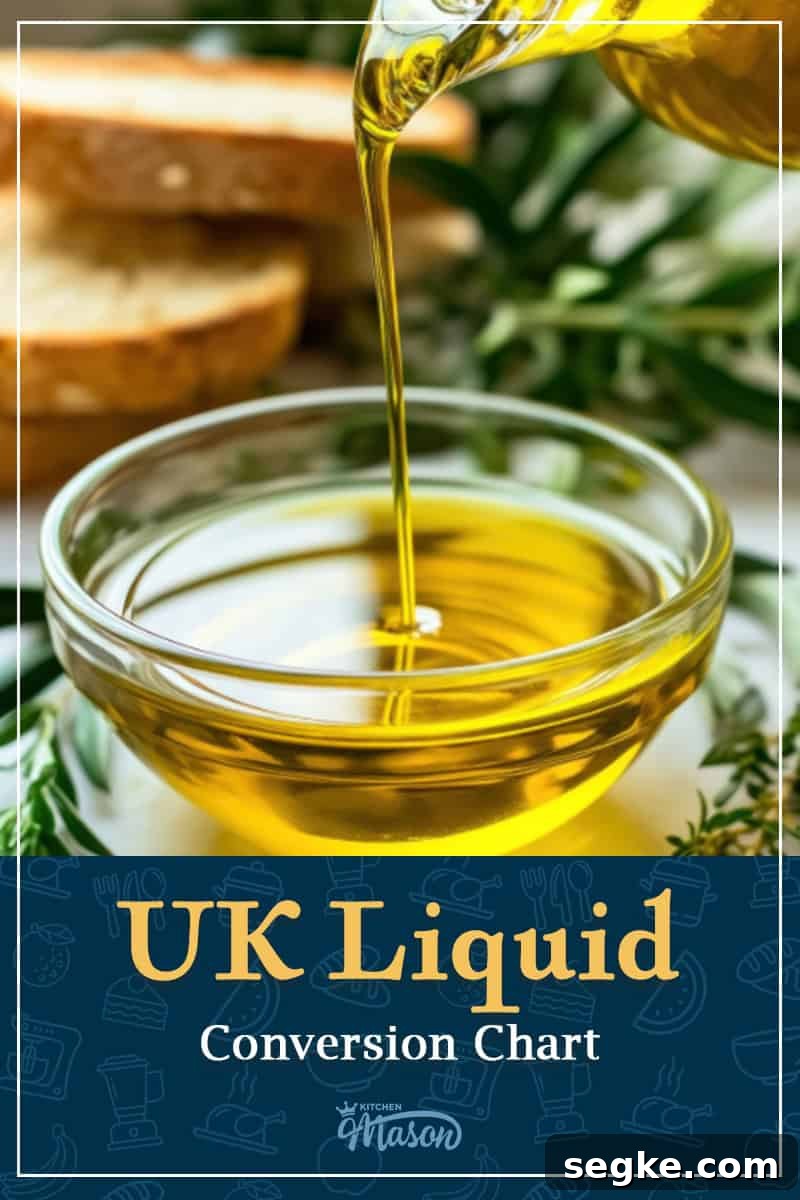
Love this liquid conversion guide? Pin it!
If you found this useful
You might also enjoy other kitchen conversion and measurement guides. These resources are helpful when adapting recipes between measurement systems or when learning basic baking measurements.
Have your say
Did this liquid conversion guide help you? If something looks off or you have a question, please share your feedback. Email: [email protected]. Your input helps make these guides clearer and more useful for everyone.